If you’re running a GoHighLevel white label business, you already understand the core value proposition. You’ve rebranded the platform, set your pricing, signed up clients, and started generating recurring revenue. The business model works. But at some point usually around the 10 to 15 client mark every white label agency owner runs into the same wall.
Support.
Your clients have questions. They need help setting up workflows. They can’t figure out why their automation didn’t fire. They want to add a new pipeline stage and don’t know how. They’re getting emails that look wrong. They need someone right now who knows the platform and can fix the problem.
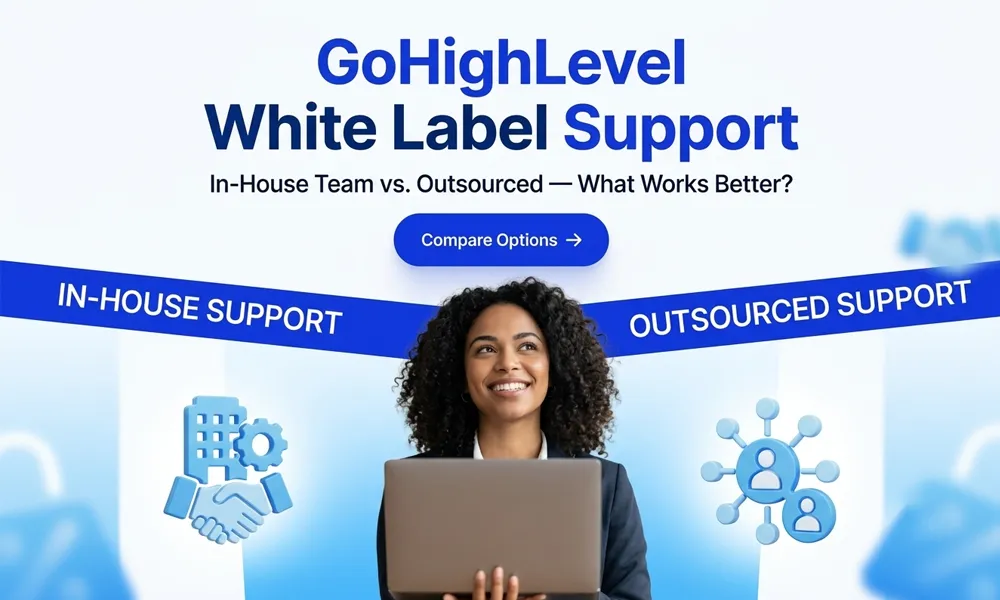
How you answer that demand determines whether your white label business scales smoothly or buckles under its own growth. And the central decision every agency owner faces is this: do you build an in-house support team, or do you outsource it?
Both models have genuine merit. Both have real limitations. And the right answer depends on factors specific to your agency your size, your margins, your client base, and where you want to take the business. This post breaks down both options honestly so you can make the right call for your situation.
What “White Label Support” Actually Means in a GHL Context
Before comparing models, it’s worth being precise about what support means when you’re running a go high level white label operation.
Unlike a typical SaaS company where clients contact the software vendor directly, white label GHL flips that dynamic entirely. Your clients believe they’re using your platform -your brand, your domain, your product. When something goes wrong or they need help, they contact you. GoHighLevel is completely invisible to them.
This means your support function needs to be capable of handling the full spectrum of GHL-related questions: workflow and automation troubleshooting, sub-account configuration, campaign setup, pipeline management, integration issues, billing questions, and basic platform navigation. Your support team whether in-house or outsourced needs to know GoHighLevel deeply, respond under your brand name, and maintain the illusion that your clients are dealing with a fully independent software company.
That’s a meaningful operational requirement. And it’s why the in-house vs. outsourced decision carries so much weight.
The In-House Support Model: What You Get and What It Costs
Building an internal support team gives you maximum control. You hire the people, train them on your platform and brand voice, define your response time standards, and manage quality directly. For agencies that have reached significant scale — 50 or more clients generating substantial monthly recurring revenue — this level of control can be worth the investment.
The advantages are real. Your in-house team develops deep familiarity with your specific client base over time. They know which clients are technically sophisticated and which need more hand-holding. They understand the nuances of your Snapshot configurations, your custom automations, and your particular setup choices. That institutional knowledge compounds and produces a genuinely high-quality support experience.
But the costs are significant and often underestimated by agency owners considering this path.
A qualified GHL support specialist commands a competitive salary. Add employer taxes, benefits, equipment, training time, and management overhead and the true cost of a single in-house support hire is considerably higher than their base salary suggests. More critically — one person can’t cover evenings, weekends, and holidays. Clients don’t stop having problems because it’s Saturday. If you want genuine coverage, you need multiple hires, which multiplies cost rapidly.
Then there’s the ramp-up problem. Hiring someone with no GHL experience means investing weeks of training before they can handle real client issues independently. Hiring someone with GHL experience means competing for scarce, in-demand talent and paying accordingly.
For most agencies operating below 40 or 50 clients, the math on in-house support simply doesn’t work. The overhead eats into the margin that makes the gohighlevel white label model attractive in the first place.
The Outsourced Support Model: Flexibility, Speed, and Margin Preservation
Outsourcing your GoHighLevel white label support means partnering with a specialist provider a team or individual already trained on GHL, already experienced in white label client interactions, and already equipped to handle your support volume under your brand name.
The advantages here are substantial, particularly for agencies in the growth phase.
Speed to deployment. An outsourced GHL support partner can be operational within days, not weeks. There’s no recruitment process, no training period, and no ramp-up lag. Your clients start receiving quality support almost immediately.
Cost efficiency. Outsourced support particularly from providers working with offshore talent delivers professional, trained GHL expertise at a fraction of the cost of an equivalent in-house hire. When you’re evaluating gohighlevel white label pricing and trying to protect your margins, this difference is significant. Every dollar saved on support overhead is a dollar that stays in your recurring revenue.
Scalability. As your client base grows, your support volume grows with it. An outsourced partner scales alongside you without the friction of additional hiring cycles. You add clients; your support capacity adjusts. There’s no lag, no recruiting, and no training backlog.
Coverage. Established outsourced support providers offer extended or even round-the-clock coverage that would be prohibitively expensive to replicate with an in-house team. For white label agencies serving clients across multiple time zones, this matters enormously.
The trade-off is a degree of control. An outsourced team isn’t embedded in your business the way an internal hire would be. Quality depends heavily on the provider you choose, the onboarding materials you give them, and how clearly you communicate your brand standards and escalation processes.
This is why the quality of your outsourced support partner matters as much as the model itself. A well-briefed, GHL-experienced outsourced team operating under clear brand guidelines will consistently outperform a rushed in-house hire trying to learn the platform while handling live client issues.
The Hybrid Model: What Most Scaling Agencies Actually Use

In practice, the agencies that have figured out white label support at scale rarely operate in a pure in-house or pure outsourced model. They use a hybrid approach — and it’s worth understanding why.
The hybrid model typically looks like this: a single internal point of contact often the agency owner or an operations manager — handles strategic client relationships, escalated issues, and quality oversight. Day-to-day tier-one support the repetitive questions, basic troubleshooting, account configuration help, and platform navigation guidance, is handled by an outsourced GHL-trained team operating under the agency’s brand.
This structure gives you the relationship depth of an in-house model at the strategic level, and the cost efficiency and scalability of outsourced delivery at the operational level. The internal person stays focused on growth and client success. The outsourced team keeps the support queue clear and response times fast.
It’s also the structure that aligns most naturally with how gohighlevel white label businesses actually grow. In the early stages, the founder handles support personally. As volume grows, an outsourced partner absorbs the load. As the business matures and margins expand, selective in-house hires are added where they deliver the most strategic value.
Making the Right Decision for Your Agency
If you’re under 20 clients, outsourced support is almost certainly the right move. The cost efficiency is undeniable, the speed to deployment is unmatched, and the quality with the right partner is more than sufficient to retain clients and build your reputation.
If you’re between 20 and 50 clients, a hybrid approach starts to make sense. Keep your outsourced support infrastructure in place and add internal capacity selectively a dedicated account manager, a client success role, or a senior technical resource for complex escalations.
If you’re above 50 clients with strong margins and a defined brand identity, the investment in a more substantial in-house team becomes justifiable. But even at this scale, most successful white label agencies maintain outsourced support for volume handling and extended coverage.
The bottom line: the support model that works best for your gohighlevel white label business is the one that keeps your clients getting fast, accurate, branded support – without eating the margin that makes the business worth running.
Get Expert GoHighLevel White Label Support Without Building a Team From Scratch
At GoHighLevel Expert, we provide specialist go high level white label support services designed specifically for agencies that want to scale without the overhead. Our team is trained on GoHighLevel, experienced in white label client interactions, and ready to operate under your brand from day one.
Whether you’re just launching your white label platform or managing dozens of client sub-accounts, we give you the support infrastructure that protects your margins, retains your clients, and frees you to focus on growth.