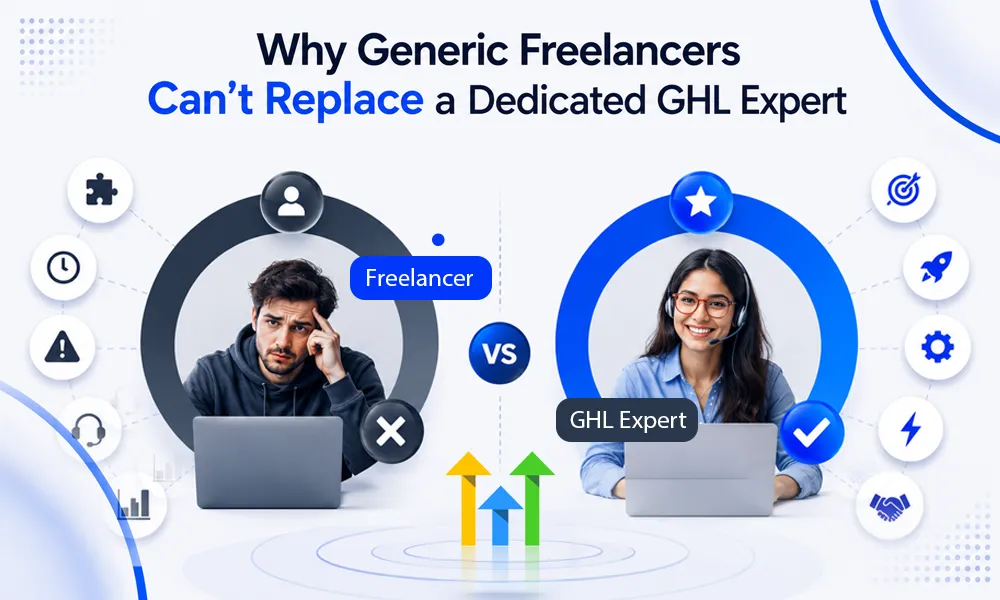
It starts with a simple brief and a confident “yes.” The freelancer knows marketing, understands funnels, and has GoHighLevel listed on their profile. The price is reasonable. The timeline sounds manageable. So you hire them. A few weeks later, the automations aren’t firing correctly, the pipeline is a mess, and the client is asking questions you don’t have answers to. What went wrong wasn’t the intent — it was the assumption that general digital marketing knowledge and genuine GoHighLevel expertise are the same thing. They’re not. And the difference between the two is exactly what this blog is about.
The Shortcut That Ends Up Costing More
Every agency owner knows the feeling. You’ve invested in GoHighLevel, you’re sold on the platform’s potential, and you need someone to set it up, build your funnels, and get your automations running. So you do what seems logical — you post a job, find a freelancer who says they know GoHighLevel, and hand over the keys.
Three weeks later, the automations are breaking. The funnel isn’t converting. The CRM workflows don’t match your actual sales process. And the freelancer who confidently said “yes” to every requirement during the interview has now gone quiet.
This isn’t a rare story. It’s one of the most common and costly mistakes agencies make when scaling with GoHighLevel — and it almost always comes down to the same root cause: mistaking general digital marketing knowledge for genuine GoHighLevel expertise.
A platform as deep, layered, and capability-rich as GoHighLevel is not something a generalist can master on the side. It requires dedicated focus, hands-on experience across dozens of use cases, and the kind of platform-specific judgment that only comes from building inside it — consistently, repeatedly, and at a professional level.
This is the difference between a generic freelancer and a dedicated GHL expert. And for agencies serious about growth, that difference is everything.
What GoHighLevel Actually Demands From the Person Running It
To understand why generalists struggle with GoHighLevel, you first need to appreciate the depth of what the platform actually contains.
GoHighLevel is not a single tool. It’s an entire business operating system — combining CRM, pipeline management, email and SMS marketing, funnel building, website creation, reputation management, calendar and appointment systems, membership platforms, and advanced automation workflows into one interconnected environment.
Each of these systems is powerful on its own. Combined, they create a platform where every element affects every other. A misconfigured trigger in an automation sequence can derail an entire pipeline. A poorly structured funnel can undermine an otherwise strong campaign. A GoHighLevel website builder setup done without understanding the platform’s native logic can produce a site that looks functional but fails to integrate correctly with the broader system.
This is not the kind of environment where surface-level familiarity translates into reliable execution. It’s an environment where depth of knowledge — earned through real, repeated experience — is what separates setups that perform from setups that constantly need fixing.
The Generic Freelancer’s Fundamental Limitation
Generic freelancers – even highly skilled ones – face a structural problem when working with GoHighLevel: their knowledge is necessarily broad rather than deep.
A generalist digital marketing freelancer may be competent in copywriting, social media, basic funnel design, and general marketing strategy. They may have dabbled in GoHighLevel for a client or two. They can navigate the platform well enough to complete straightforward tasks.
But “well enough” is not what GoHighLevel requires for agency-level deployment. The platform rewards deep expertise. It penalizes shallow implementation.
Here’s where the gap shows up most clearly:
Automation Architecture: Building GoHighLevel automations that actually work — across multiple triggers, conditional branches, time delays, and integration points — requires a thorough understanding of the platform’s logic. A generalist builds automations that work in demos. A dedicated GHL expert builds automations that work in production, at scale, across diverse client scenarios, and without breaking when edge cases appear.
GoHighLevel Website Builder Expertise: The GoHighLevel website builder is a capable platform with its own native logic, design constraints, and integration requirements. Building high-converting, properly integrated websites inside GoHighLevel is not the same as building websites in WordPress or Webflow. A generalist applies generic web-building knowledge to a platform-specific tool and produces results that are structurally compromised. A GHL expert understands how the website builder connects to the broader GoHighLevel ecosystem – forms, pipelines, automations, tracking — and builds accordingly.
Funnel Strategy and Implementation: Funnels inside GoHighLevel are not just design exercises. They’re conversion systems that depend on correct integration with CRM pipelines, email sequences, SMS follow-ups, and booking systems. Getting this right requires platform-specific knowledge of how each element connects and what can go wrong when it doesn’t. Generalists see the design layer. GHL experts see the full system.
Troubleshooting and Optimization: When something breaks inside GoHighLevel — and something always eventually does — the speed and accuracy of diagnosis depends entirely on how well the person understands the platform’s internal logic. A generalist faces a steep debugging curve every time. A dedicated GoHighLevel developer has encountered most failure modes before and resolves them efficiently, often before they impact client operations.
The Real Cost of Getting This Wrong
The financial case for hiring a dedicated GHL expert rather than a generic freelancer becomes very clear when you account for the full cost of the alternative.
Rework costs: When a generalist’s GoHighLevel setup needs to be rebuilt — and it often does, you pay for the original work, the time lost, and the expert who eventually fixes it. That’s triple the cost of hiring correctly the first time.
Lost client revenue: A poorly configured CRM pipeline means leads fall through. A broken automation means follow-ups don’t happen. A non-converting funnel means ad spend goes to waste. These aren’t abstract inefficiencies, they’re directly measurable revenue losses.
Agency reputation damage: If you’re a marketing agency delivering GoHighLevel as a service to clients, substandard implementation doesn’t just cost you money. It costs you client trust, retention, and referrals. A single poorly executed GoHighLevel deployment can undo months of relationship-building.
Founder time: Every hour you spend trying to diagnose what a generalist got wrong, briefing a new freelancer, or managing client complaints about broken automations is an hour you’re not spending on growth, sales, or strategy. The opportunity cost of repeatedly fixing inadequate GoHighLevel setups is one of the most underacknowledged costs in agency operations.
What a Dedicated GHL Expert Actually Brings to the Table

The value of a dedicated GHL expert is not just technical competence — though that’s foundational. It’s the combination of platform depth, strategic thinking, and operational experience that produces results a generalist structurally cannot.
A true GoHighLevel developer brings:
Platform mastery across the full stack — from CRM configuration and pipeline design to advanced automation architecture, the GoHighLevel website builder, funnel optimization, and API integrations.
Proactive problem prevention — the ability to anticipate configuration issues, integration failures, and scaling bottlenecks before they become problems, because they’ve encountered them before.
Agency-specific context — an understanding of how GoHighLevel operates in real agency environments, where multiple clients, diverse use cases, and high-stakes deliverables demand more than basic platform familiarity.
Speed of execution — because every element of the platform is familiar, a dedicated GHL expert moves faster, makes fewer errors, and delivers results on timelines that a generalist learning on the job simply cannot match.
Strategic input — the best GHL experts don’t just execute what they’re told. They bring platform-specific strategic insight that improves the brief itself — suggesting better automation approaches, identifying funnel weaknesses, and recommending configurations that align with the agency’s actual business goals.
The Hiring Decision That Defines Your GoHighLevel ROI
GoHighLevel is one of the most powerful platforms available to marketing agencies today. But its power is only accessible to the businesses that implement it correctly – and correct implementation requires the right expertise.
Choosing a generic freelancer to save money on your GoHighLevel setup is one of the most reliably expensive decisions an agency can make. The short-term saving almost always generates a medium-term cost that far exceeds what a dedicated expert would have charged from the start.
The agencies growing fastest on GoHighLevel – retaining more clients, delivering better results, and scaling their operations without constant technical firefighting, are the ones that made the right hiring decision early: a dedicated GoHighLevel developer with the platform depth, strategic experience, and professional commitment that generic freelancers simply cannot match.
Stop Settling for Generalists. Hire a Dedicated GHL Expert Today
GoHighLevel Expert connects agencies and businesses with dedicated, platform-certified GHL specialists who know GoHighLevel inside and out, from advanced automation architecture to full GoHighLevel website builder deployments.
Whether you need a senior GoHighLevel developer to build your agency’s entire backend or an expert to audit and fix an existing setup, GoHighLevel Expert has the right specialist ready.